
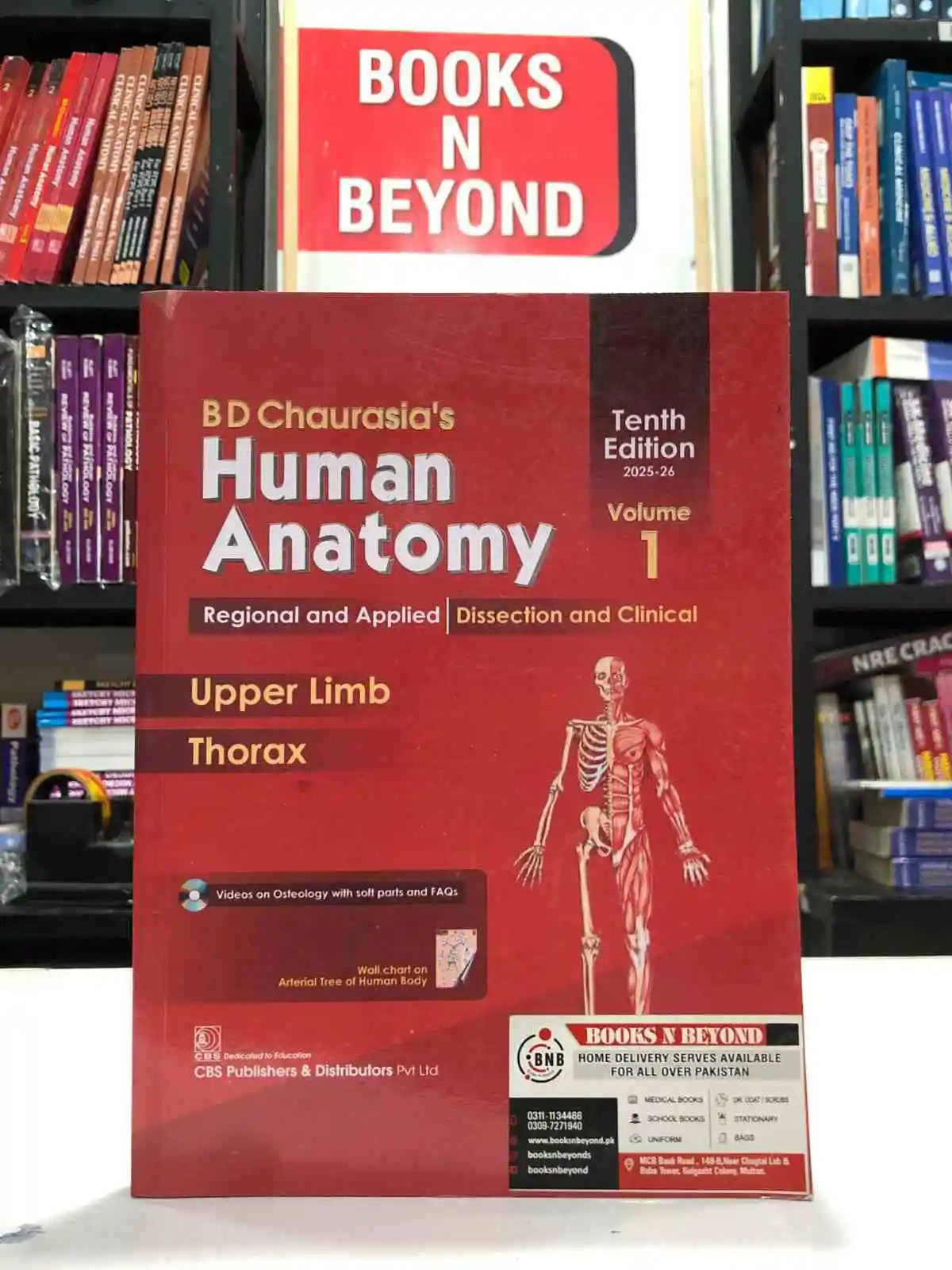
BD Chaurasia’s Human Anatomy Volume 1 8th Edition
Price range: ₨ 299 through ₨ 899 item
Short Book Details
- Book Name: BD Chaurasia’s Human Anatomy, Volume 1
- Edition: Eighth Edition
- Main Coverage: Upper Limb and Thorax
- Author: B.D. Chaurasia
- Chief Editor: Krishna Garg
- Editors: Pragati Sheel Mittal, Mrudula Chandrupatla
- Publisher: CBS Publishers & Distributors
BD Chaurasia’s Human Anatomy Volume 1 8th Edition
BD Chaurasia’s Human Anatomy, Volume 1, Eighth Edition covers the Upper Limb and Thorax through Regional and Applied Dissection and Clinical anatomy. The book connects theoretical anatomy, practical dissection, anatomical descriptions, and clinical applications, making it useful for medical students studying structures alongside their clinical relevance. The 8th edition follows the Competency Based Undergraduate Curriculum for the Indian Medical Graduate, 2018.
The revised edition includes updated text, modified illustrations, new diagrams, and revised material arranged around undergraduate medical learning. Its regional approach helps students study individual structures according to their anatomical relationships instead of treating every structure in isolation. Volume 1 is specifically focused on the Upper Limb and Thorax, with practical and clinical points placed alongside core anatomy.
Upper Limb
The Upper Limb section presents regional anatomy with an applied anatomy approach. Students can study bones, joints, the pectoral region, axilla, nerves, vessels, muscles, and related anatomical structures while keeping their clinical applications in view.
For students preparing for practical anatomy, this regional structure is useful because upper limb anatomy is easier to revise when bones, joints, muscles, vessels, nerves, and surrounding structures are studied according to their actual regional relationships.
Introduction to the Upper Limb
The opening discussion introduces the parts of the upper limb, the upper limb as an anatomical region, and the organization of the upper extremity. It also gives students a starting point for understanding the evolution of upper limbs, anatomical organization, and the study of anatomy.
This section can help a student establish a basic map before moving toward individual anatomical regions. Frequently Asked Questions and FAQs also support quick revision when students return to the opening concepts before practical or written examinations.
Bones of the Upper Limb
The study of the bones of the upper limb includes the clavicle, scapula, humerus, radius, and ulna. Attention is given to anatomical landmarks, joints, capsular attachments, and the structure of the upper limb skeleton.
The section also addresses ossification, including the ossification of humerus, ossification of radius, and ossification of ulna. These details are useful when students are connecting bone anatomy with developmental and clinical questions.
Students can also use the clinical material to relate bony structures, anatomical landmarks, and clinicoanatomical problems. The combination of regional anatomy and clinical relevance gives the skeletal material a practical purpose beyond memorising names.
Pectoral Region
The pectoral region introduces surface landmarks, superficial fascia, deep fascia, muscles, the breast, lymphatic drainage, and related clinical anatomy. The section also includes dissection material that can support students during practical anatomy sessions.
Topics such as the serratus anterior, pectoral muscles, fascia, lymphatics, breast anatomy, and anatomical landmarks help students connect structures with their position and function.
For revision, the section includes mnemonics, facts to remember, clinicoanatomical problems, further reading, Frequently Asked Questions, Multiple Choice Questions, MCQs, and Viva Voce material.
Axilla and Related Upper Limb Anatomy
The axilla is studied as a defined axillary region within the upper limb. Its anatomical structures are presented through regional relationships involving nerves, vessels, muscles, lymph nodes, and surrounding structures.
This approach helps students understand how different upper limb structures occupy the same anatomical space and how their relationships matter in clinical anatomy, dissection, and applied anatomy.
Clinical Anatomy and Applied Anatomy
The clinical sections connect anatomical structures with practical medical situations. Instead of treating clinical anatomy as a separate subject, the book places clinical applications, clinical correlations, and medical applications alongside regional anatomy.
This can help undergraduate students build the habit of asking where a structure is located, what lies around it, and why that relationship matters during examination, diagnosis, procedures, or practical anatomy.
Thorax
The Thorax section covers thoracic anatomy, regional anatomy, applied anatomy, and dissection. It includes the thoracic wall, thoracic cavity, pleurae, lungs, mediastinum, pericardium, heart, great vessels, trachea, esophagus, and thoracic duct.
The coverage also includes the superior vena cava, aorta, pulmonary trunk, surface marking, and radiological anatomy. These topics give students a way to connect anatomical structures with clinical interpretation and practical anatomy.
Bones and Joints of the Thorax
The bones of the thorax and joints of the thorax form the structural framework of the chest. Their arrangement is studied alongside the thoracic skeleton, thoracic wall, and thoracic cavity.
For undergraduate medical students, this section provides the anatomical base needed to understand movement, protection of thoracic organs, regional relationships, and clinical anatomy involving the chest.
Thoracic Wall
The thoracic wall includes the relevant muscles, fascia, ribs, and intercostal spaces. The material focuses on their anatomical relationships and clinical relevance within the thorax.
Understanding these structures together is useful during practical anatomy because the thoracic wall is not simply a collection of separate muscles and bones. Their position, attachments, and relationships help explain the structure of the thorax.
Thoracic Cavity and Pleurae
The thoracic cavity and pleurae are studied through regional anatomy and their anatomical relationships. The section introduces the pleural cavity and surrounding thoracic structures while connecting the material with clinical applications.
This arrangement helps students understand how pleural anatomy relates to the lungs, thoracic wall, and other structures within the chest.
Lungs
The lungs are studied within the thorax and thoracic cavity, with attention to pulmonary anatomy, respiratory structures, pulmonary structures, and their anatomical relationships.
The regional approach allows students to connect the lungs with surrounding structures rather than studying pulmonary anatomy as an isolated topic. Applied anatomy adds a practical layer to the basic structural information.
Mediastinum
The mediastinum is presented as a major region of the thoracic cavity containing important mediastinal structures. The discussion focuses on anatomical relationships between the structures located within the thorax.
This regional approach can help students revise the location of thoracic structures and understand why these relationships matter in clinical anatomy.
Pericardium and Heart
The pericardium and heart are covered through cardiovascular anatomy, regional anatomy, and applied anatomy. Students can study cardiac structures and pericardial structures while relating them to the surrounding thoracic cavity.
The emphasis on anatomical relationships is useful for understanding how the heart sits within the thorax and how nearby structures relate to cardiac anatomy and clinical relevance.
Great Vessels of the Thorax
The section on great vessels covers major blood vessels of the thorax, including the superior vena cava, aorta, and pulmonary trunk.
Students can study these vascular structures according to their regional position, relationships, and clinical relevance. This makes the topic useful for both cardiovascular anatomy and practical examination revision.
Trachea, Esophagus and Thoracic Duct
The trachea, esophagus, and thoracic duct are studied within the thorax and thoracic cavity. Their relationships with nearby structures provide a regional view of the respiratory system, digestive system, and lymphatic system.
This section is particularly useful when students need to understand how structures from different body systems occupy and interact within the same anatomical region.
Surface Marking and Radiological Anatomy of the Thorax
Surface marking gives students a practical way to identify thoracic structures on the body surface. The section on radiological anatomy adds another method of anatomical identification through imaging.
For medical students, these skills are useful during practical anatomy, clinical interpretation, and examination preparation. Surface landmarks, imaging, and radiological identification can make the relationship between textbook anatomy and the living body easier to understand.
Learning and Revision Features
The book includes several features designed around undergraduate medical learning and revision:
- Clinical anatomy and applied clinical points
- Mnemonics for difficult factual details
- Facts to remember for quick recall
- Clinicoanatomical problems for applied understanding
- Further reading for students who want additional study material
- Frequently Asked Questions and FAQs
- Multiple Choice Questions and MCQs
- Viva Voce support for practical examinations
- Muscle tables for structured revision
- Tables showing actions at joints
- Tables covering branches of nerves
- Tables covering branches of arteries
- Detailed illustrations and diagrams
- Anatomical relationships for practical learning
- Material that supports examination answers
These features can be useful when a student moves from reading a chapter to revising it shortly before a written paper, viva, or practical examination.
Praise and Reviews
Student response can vary by learning style and course requirements, so individual reviews should be read alongside the actual edition and syllabus. Current book listings confirm that Volume 1 is available as the 8th Edition and is commonly listed for anatomy study.
The book’s strong focus on regional anatomy, clinical connections, illustrations, tables, and practical learning makes it particularly relevant for students who prefer studying structures through their anatomical relationships.
About the Author
B.D. Chaurasia is the original author associated with the Human Anatomy series. The eighth edition of Volume 1 is presented under the chief editorship of Krishna Garg, with Pragati Sheel Mittal and Mrudula Chandrupatla as editors. The edition was published by CBS Publishers & Distributors.
The editorial team brings the book into line with the stated undergraduate curriculum while retaining the regional, applied, dissection, and clinical orientation associated with the series.
What You Achieve By This Book
After working through the relevant chapters, a medical student can build a stronger understanding of:
- Regional anatomy of the Upper Limb and Thorax
- Major bones, joints, muscles, nerves, arteries, and vessels
- Anatomical landmarks and regional relationships
- Clinical anatomy linked with individual structures
- Practical dissection concepts
- Thoracic and upper limb surface anatomy
- Radiological anatomy of the thorax
- Muscle actions and methods of testing
- Branches of nerves and arteries
- Clinicoanatomical problems
- Written examination and Viva Voce preparation
- Quick revision through MCQs, FAQs, mnemonics, and tables
Price in Pakistan
The provided price is PKR 299 for the Black & White version and PKR 899 for the Matt Paper version.
Prices can vary across platforms and sellers depending on paper quality, printing, edition availability, and other product conditions.
Availability
BD Chaurasia’s Human Anatomy Volume 1 8th Edition is available at Books N Beyonds Book Store for students looking for an anatomy textbook covering the Upper Limb and Thorax.
FAQs
Is BD Chaurasia’s Human Anatomy Volume 1 the 8th Edition?
Yes. BD Chaurasia’s Human Anatomy Volume 1 is available in the Eighth Edition, covering Upper Limb and Thorax. The ISBN associated with this edition is 978-93-88902-73-1.
What topics are covered in Volume 1?
Volume 1 mainly covers the Upper Limb and Thorax, including bones, joints, pectoral region, axilla, thoracic wall, pleurae, lungs, mediastinum, heart, great vessels, trachea, esophagus, thoracic duct, surface marking, and radiological anatomy.
Is this book useful for MBBS students?
Yes it is Usefull for MBBS students. It is designed around undergraduate medical anatomy learning and includes regional anatomy, applied anatomy, dissection, clinical correlations, illustrations, tables, MCQs, FAQs, and Viva Voce material.
Does Volume 1 include clinical anatomy?
Yes. Clinical anatomy and applied anatomy are integrated with the regional coverage. Students can relate anatomical structures and relationships to clinical applications and clinicoanatomical problems.
| Weight | 350 g |
|---|---|
| Dimensions | 8 × 4 × 2 cm |
| Choose an Option | Black & White, Matt Paper |

Related products

Gray’s Anatomy For Students 6th International Edition (2 Volumes) Matt Paper
Short Product Description
- Book: Gray's Anatomy For Students
- Listed Edition: 6th International Edition
- Format: 2 Volumes, Matt Paper
- Authors: Richard L. Drake, A. Wayne Vogl, Adam W. M. Mitchell
- Publisher: Elsevier
- Subject: Human Anatomy
- Useful For: MBBS students, medical students, anatomy learners, health sciences students

Guyton and Hall Textbook of Medical Physiology 15th Edition
Short Product Information
- Book Name: Guyton and Hall Textbook of Medical Physiology
- Edition: 15th Edition
- Authors: John E. Hall and Michael E. Hall
- Publisher: Elsevier
- Publication Year: 2025
- Level: MBBS, BDS, Pharm D, Physiotherapy, FCPS, postgraduate learners
- Useful For: Physiology study, medical education, clinical foundation, examination preparation


Key To BDS Block 3 Medico Express For 1st Year BDS 2026
Short Product Description
- Book Name: Key To BDS Block 3 Medico Express for 1st Year BDS
- Edition: 2026
- Authors: Dr Hunzala Siddiq Khan and Dr Zoenoor Usman
- Publisher: Zubair Book Depot
- Pages: 514
Order Key To BDS Block 3 Medico Express for 1st Year BDS 2026 from Books N Beyonds at the listed price of PKR 1,690.
Students can buy online in Pakistan and select Cash on Delivery at checkout, where available, for a convenient way to receive their book.


Medico Express Block 1 For 1st Year BDS 2nd Edition
Quick Summary of the Book
-
Book Name: Medico Express Block 1 For 1st Year BDS
-
Edition: 2nd Edition
-
Authors: Dr. Hunzala Siddiq Khan, Dr. Fiza Ijaz Gondal, Dr. Zeenoor Usman
-
Publisher: ZUBAIR BOOK DEPOT
Prepare for first-year BDS assessments with the Medico Express Block 1 For 1st Year BDS 2nd Edition, featuring theory coverage and exam-focused revision material.
Order from Books N Beyonds Book Store for PKR 1,795, subject to current availability.
Netter Atlas Of Human Anatomy 8th Edition
Quick Summary of the Book
- Book Name: Netter Atlas of Human Anatomy
- Edition: 8th Edition
- Author: Frank H. Netter, MD
- Publisher: Elsevier
Order the Netter Atlas of Human Anatomy 8th Edition from Books N Beyonds Book Store for detailed anatomical illustrations and a dependable study reference.
Add this essential anatomy resource to a medical study collection and strengthen anatomical understanding through regular visual revision.

Orban’s Oral Histology & Embryology Edition 2025–2026
Short Product Details
- Book Name: Orban’s Oral Histology & Embryology
- Edition: 2025–2026, listed as 16th Edition
- Author: G. S. Kumar
- Publisher: Elsevier India / RELX India associated with earlier edition records
- Subject: Oral Histology and Embryology
- Useful For: BDS students, dental students, dentistry learners, pre-clinical studies


Sharjeel’s Human Embryology 7th Edition with Embryology Chart
Quick Summary of the Book
- Book Name: Sharjeel's Human Embryology with Embryology Chart
- Edition: 7th Edition
- Author: Sharjeel Usmani
- Publisher: Farooq Kitab Ghar
Strengthen embryology revision with Sharjeel's Human Embryology 7th Edition with Embryology Chart, available for PKR 695.
Order from Books N Beyonds Book Store and check availability before purchasing.


Reviews
There are no reviews yet.