
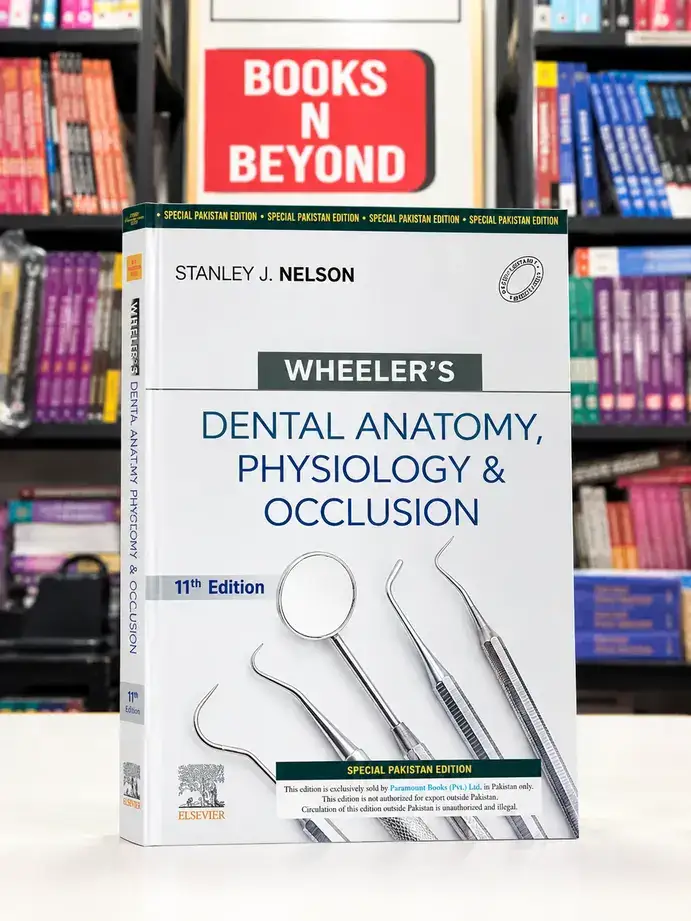
Wheeler’s Dental Anatomy, Physiology & Occlusion 11th Edition
₨ 2,595 item
Short Product Description
- Book: Wheeler’s Dental Anatomy, Physiology & Occlusion
- Edition: 11th Edition
- Author: Stanley J. Nelson, DDS, MS
- Publisher: Elsevier
Wheeler’s Dental Anatomy, Physiology & Occlusion 11th Edition
Wheeler’s Dental Anatomy, Physiology & Occlusion 11th Edition by Stanley J. Nelson is a detailed dental textbook covering dental anatomy, physiology, occlusion, tooth form, and tooth function. It connects basic anatomy with clinical applications, helping BDS students understand why individual tooth features matter during diagnosis, restorative procedures, prosthodontics, orthodontics, and everyday clinical practice.
The book covers primary dentition and permanent dentition, with focused discussion of tooth morphology, developmental features, crown and root anatomy, contact areas, cusps, ridges, grooves, pulp structures, supporting tissues, muscles, nerves, and functional relationships. Its clinical emphasis also makes it useful for restorative dentistry, crown and bridge work, complete dentures, partial dentures, orthodontic treatment planning, and occlusal rehabilitation.
For a first year or second year BDS student, the value often becomes clearer when tooth identification moves from memorization to actual examination. The book supports that shift through detailed illustrations, clinical photographs, tooth trait tables, labeling exercises, 360 degree animations, 3 D learning resources, and step by step videos. The 11th edition also includes access to Expert Consult resources.
Key Features
Detailed Dental Anatomy Coverage
- Dental anatomy, tooth structure, tooth morphology, and tooth function are explained alongside the anatomical structures that make each tooth identifiable. This gives students a practical foundation for understanding oral structures and their clinical significance.
Primary and Permanent Dentition
- The book covers primary teeth, deciduous teeth, and permanent teeth, making it easier to compare tooth anatomy, developmental characteristics, morphology, and identification across different stages of dentition.
Development and Eruption
- Tooth development and tooth eruption are discussed from the prenatal period and in utero stage through adolescence and adulthood, with attention to developmental progression and changing tooth morphology.
Permanent Maxillary Incisors
- Students can study permanent maxillary incisors through crown morphology, root morphology, contact areas, developmental features, ridges, grooves, and functional anatomy, supporting accurate tooth identification.
Permanent Mandibular Incisors
- The section on permanent mandibular incisors examines tooth form and function through crown and root characteristics, developmental features, contact areas, ridges, grooves, and other identifying details.
Maxillary and Mandibular Canines
- Permanent maxillary canines and permanent mandibular canines receive focused treatment of canine morphology, crown morphology, root morphology, cusps, ridges, grooves, contact areas, and functional anatomy.
Maxillary Premolars
- The discussion of permanent maxillary premolars focuses on premolar morphology, crown and root anatomy, cusps, ridges, grooves, developmental features, contact areas, and tooth identification.
Mandibular Premolars
- Permanent mandibular premolars are examined through their morphology, crown structure, root form, developmental characteristics, contact areas, cusps, ridges, grooves, and relationship to tooth function.
Maxillary and Mandibular Molars
- Detailed coverage of permanent maxillary molars and permanent mandibular molars helps learners distinguish molar morphology through crown morphology, root morphology, cusps, ridges, grooves, developmental features, and functional anatomy.
Pulp Chambers and Canals
- The book explains pulp chambers, pulp canals, dental pulp, chamber anatomy, canal anatomy, internal tooth anatomy, and root canal anatomy, giving students a clearer view of internal tooth structures.
Dento Osseous Structures
- Coverage of dento osseous structures, blood vessels, and nerves connects teeth with their supporting tissues. The section also highlights vascular structures, neural structures, osseous structures, and their anatomical relationships.
Orofacial Complex
- The orofacial complex is explored through anatomical form, physiological function, oral structures, facial structures, dental structures, facial function, oral function, and the functional relationships between these components.
Temporomandibular Joint and Muscles
- The relationship between temporomandibular joints, TMJ, teeth, muscles, and mandibular movements is linked with masticatory function, mastication, jaw movement, joint function, and mandibular function.
Occlusion
- The occlusion section covers dental occlusion, centric occlusion, centric relation, cusp fossa relationships, occlusal curves, guidance mechanisms, mandibular movements, bite relationships, and occlusal anatomy.
Clinical Applications
- Clinical learning extends to root planing, scaling, extraction techniques, extraction forces, fillings, pulp, enamel form, premature occlusal contacts, occlusal adjustment, arch form, and bite splint designs.
Visual Learning Resources
- More than 800 full color images, anatomical illustrations, and clinical photographs support visual learning. The publisher also describes interactive 360 degree and 3 D resources for tooth identification and examination.
Tooth Trait Tables
- Tooth trait tables provide a useful reference for permanent dentition, tooth notation, dimensions, proximal contacts, proximal contact positions, heights, curvatures, dental measurements, and individual tooth characteristics.
Review of Tooth Morphology
- Review of Tooth Morphology provides a compact way to revisit tooth development, tooth identification, crown morphology, root morphology, primary teeth, permanent teeth, prenatal development, adolescence, adulthood, and developmental progression.
Interactive Learning Resources
- Expert Consult adds electronic text, learning activities, animations, hands on resources, quizzes, examinations, and other interactive content. These resources can support visual learning and repeated tooth examination outside the printed page.
Labeling Exercises
- Labeling exercises allow students to work with tooth structures, facial anatomy, facial structures, and anatomical identification through interactive drag and drop labels.
Occlusal Adjustment Videos
- Occlusal adjustment videos present step by step videos focused on occlusal adjustment, occlusal contacts, clinical techniques, dental procedures, and practical clinical applications.
Clinical Case Studies
- The clinical applications chapter includes case studies that connect dental anatomy, physiology, occlusion, practical dentistry, restorative dentistry, prosthodontics, orthodontics, and occlusal rehabilitation with examination preparation.
Praise and Reviews
The following are suitable sample buyer feedback statements for product presentation. They should be treated as illustrative feedback rather than verified customer reviews.
- “The illustrations make tooth identification much easier, especially during practical preparation.”
- “The occlusion and clinical application sections help connect basic dental anatomy with actual dentistry.”
- “The tooth trait tables are useful for quick revision before BDS examinations.”
- “The combination of detailed text, images, and interactive learning resources makes the subject easier to study.”
About the Author
Stanley J. Nelson, DDS, MS is the author of Wheeler’s Dental Anatomy, Physiology & Occlusion 11th Edition. He is a Professor at the University of Nevada Las Vegas School of Dental Medicine. His work on this textbook focuses on dental anatomy, physiology, occlusion, tooth morphology, and their clinical applications.
What You Achieve By This Book
By studying this book, dental students can build a stronger working understanding of tooth form, tooth function, anatomical structures, and occlusal relationships. It can support both classroom learning and practical examination preparation.
Students can use it to:
- Identify primary teeth and permanent teeth using anatomical characteristics.
- Understand crown morphology and root morphology.
- Recognize cusps, ridges, grooves, contact areas, and developmental features.
- Review tooth development and eruption.
- Study pulp chambers, pulp canals, blood vessels, nerves, and supporting structures.
- Relate teeth and muscles to mastication and mandibular movement.
- Understand centric occlusion, centric relation, and cusp fossa relationships.
- Connect dental anatomy with restorative dentistry, prosthodontics, orthodontics, and clinical dentistry.
- Practice tooth identification through illustrations and interactive learning.
- Prepare for dental anatomy, physiology, and occlusion examinations.
Price in Pakistan
The listed price for Wheeler’s Dental Anatomy, Physiology & Occlusion 11th Edition is PKR 2,595 at Books N Beyonds. Prices can vary across different platforms based on edition, seller, availability, printing, shipping, and whether the copy is imported or locally supplied.
Availability
Wheeler’s Dental Anatomy, Physiology & Occlusion 11th Edition is available at Books N Beyonds Book Store for dental students, BDS learners, postgraduate students, and practicing dentists looking for a detailed reference on dental anatomy, physiology, morphology, and occlusion.
FAQs
Is Wheeler’s Dental Anatomy, Physiology & Occlusion 11th Edition useful for BDS students?
Yes. It is particularly relevant to BDS students studying dental anatomy, tooth morphology, physiology, occlusion, tooth identification, and clinical applications. It can also support first year and second year dental studies.
Who wrote Wheeler’s Dental Anatomy, Physiology & Occlusion 11th Edition?
The book is written by Stanley J. Nelson, DDS, MS, Professor at the University of Nevada Las Vegas School of Dental Medicine.
What topics are covered in Wheeler’s Dental Anatomy 11th Edition?
The book covers dental anatomy, tooth development and eruption, primary dentition, permanent incisors, canines, premolars, molars, pulp chambers and canals, dento osseous structures, blood vessels, nerves, TMJ, muscles, occlusion, and clinical applications.
Does the book cover tooth identification?
Yes. Tooth identification is supported through detailed anatomical descriptions, tooth morphology, tooth trait tables, illustrations, labeling exercises, and interactive learning resources.
Does Wheeler’s Dental Anatomy 11th Edition cover occlusion?
Yes. It includes dental occlusion, centric occlusion, centric relation, cusp fossa relationships, occlusal curves, mandibular movements, guidance mechanisms, bite relationships, and clinical occlusal adjustment.
Does the book include clinical applications?
Yes. The clinical applications section connects dental anatomy, physiology, and occlusion with root planing, scaling, extraction techniques, fillings, pulp and enamel form, premature occlusal contacts, occlusal adjustment, arch form, and bite splint designs.
Does the 11th Edition include visual learning resources?
Yes. The edition includes more than 800 full color images, anatomical illustrations, clinical photographs, labeling exercises, and access to interactive Expert Consult resources described by the publisher.
Is this book useful for postgraduate students and practicing dentists?
It can be useful as a reference for postgraduate students and practicing dentists who need to revisit tooth morphology, anatomical relationships, occlusion, and clinical applications connected with restorative dentistry, prosthodontics, orthodontics, and occlusal rehabilitation.
| Weight | 350 g |
|---|---|
| Dimensions | 8 × 4 × 2 cm |

Related products


Key To BDS Block 3 Medico Express For 1st Year BDS 2026
Short Product Description
- Book Name: Key To BDS Block 3 Medico Express for 1st Year BDS
- Edition: 2026
- Authors: Dr Hunzala Siddiq Khan and Dr Zoenoor Usman
- Publisher: Zubair Book Depot
- Pages: 514
Order Key To BDS Block 3 Medico Express for 1st Year BDS 2026 from Books N Beyonds at the listed price of PKR 1,690.
Students can buy online in Pakistan and select Cash on Delivery at checkout, where available, for a convenient way to receive their book.


Medico Express Block 1 For 1st Year BDS 2nd Edition
Quick Summary of the Book
-
Book Name: Medico Express Block 1 For 1st Year BDS
-
Edition: 2nd Edition
-
Authors: Dr. Hunzala Siddiq Khan, Dr. Fiza Ijaz Gondal, Dr. Zeenoor Usman
-
Publisher: ZUBAIR BOOK DEPOT
Prepare for first-year BDS assessments with the Medico Express Block 1 For 1st Year BDS 2nd Edition, featuring theory coverage and exam-focused revision material.
Order from Books N Beyonds Book Store for PKR 1,795, subject to current availability.
Netter Atlas Of Human Anatomy 8th Edition
Quick Summary of the Book
- Book Name: Netter Atlas of Human Anatomy
- Edition: 8th Edition
- Author: Frank H. Netter, MD
- Publisher: Elsevier
Order the Netter Atlas of Human Anatomy 8th Edition from Books N Beyonds Book Store for detailed anatomical illustrations and a dependable study reference.
Add this essential anatomy resource to a medical study collection and strengthen anatomical understanding through regular visual revision.
Orban’s Oral Histology & Embryology Edition 2025–2026
Short Product Details
- Book Name: Orban’s Oral Histology & Embryology
- Edition: 2025–2026, listed as 16th Edition
- Author: G. S. Kumar
- Publisher: Elsevier India / RELX India associated with earlier edition records
- Subject: Oral Histology and Embryology
- Useful For: BDS students, dental students, dentistry learners, pre-clinical studies


Sharjeel’s Human Embryology 7th Edition with Embryology Chart
Quick Summary of the Book
- Book Name: Sharjeel's Human Embryology with Embryology Chart
- Edition: 7th Edition
- Author: Sharjeel Usmani
- Publisher: Farooq Kitab Ghar
Strengthen embryology revision with Sharjeel's Human Embryology 7th Edition with Embryology Chart, available for PKR 695.
Order from Books N Beyonds Book Store and check availability before purchasing.


Reviews
There are no reviews yet.